

When Does Workplace AI Cross the Line?
The new AI economy is being trained on your work. You probably never agreed to it.

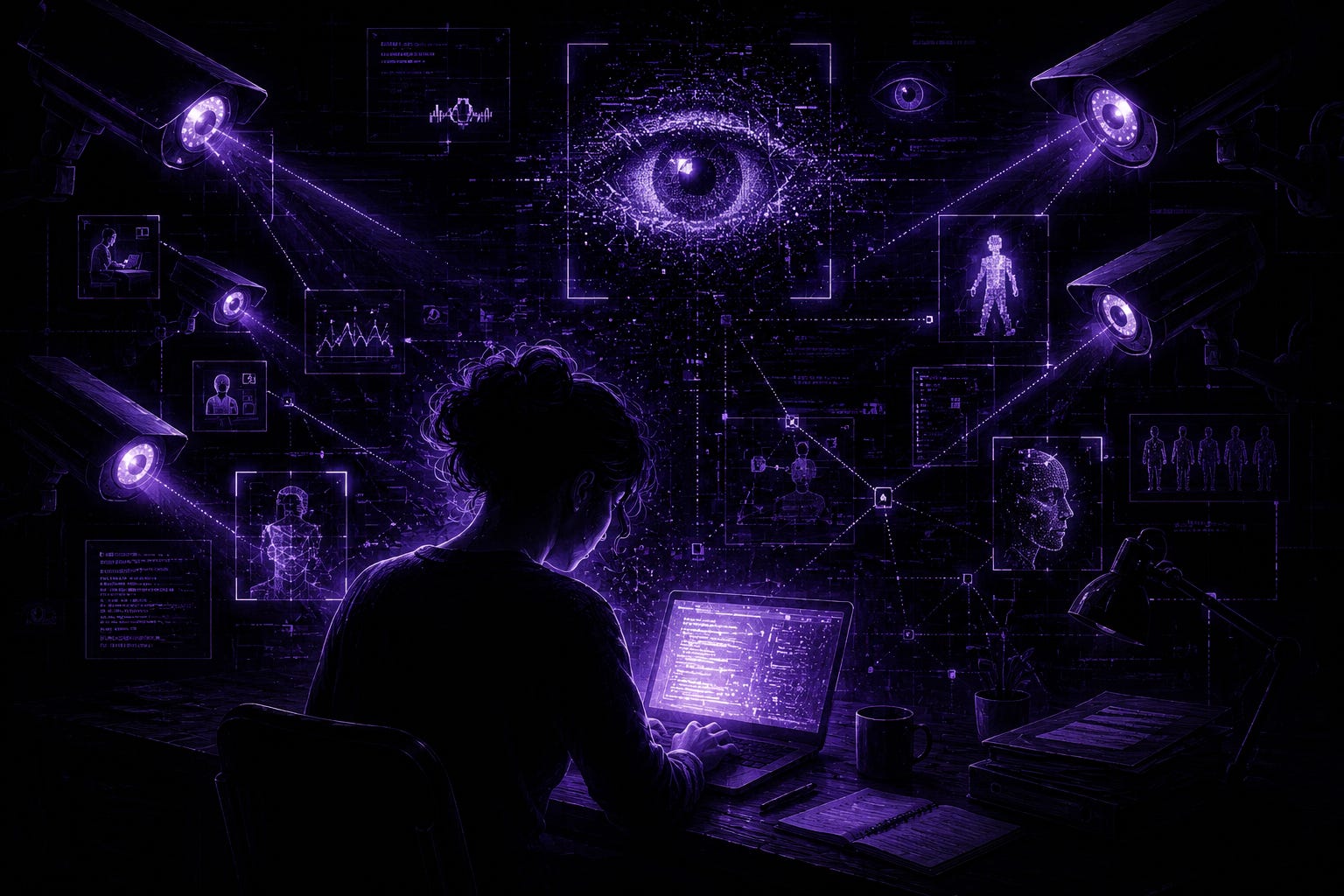
Nearly three-quarters of U.S. employers now use digital tools to monitor workers. And no federal law requires them to disclose it.
That gap is the consent problem at the heart of the new AI economy. The same data captured to “measure productivity” includes how people move through their work, where their attention lands, and the rhythms of their reasoning. That data is being repurposed to train AI agents that can replicate it. The labor question is no longer whether AI will replace workers, but what AI is learning from them, and on what terms.
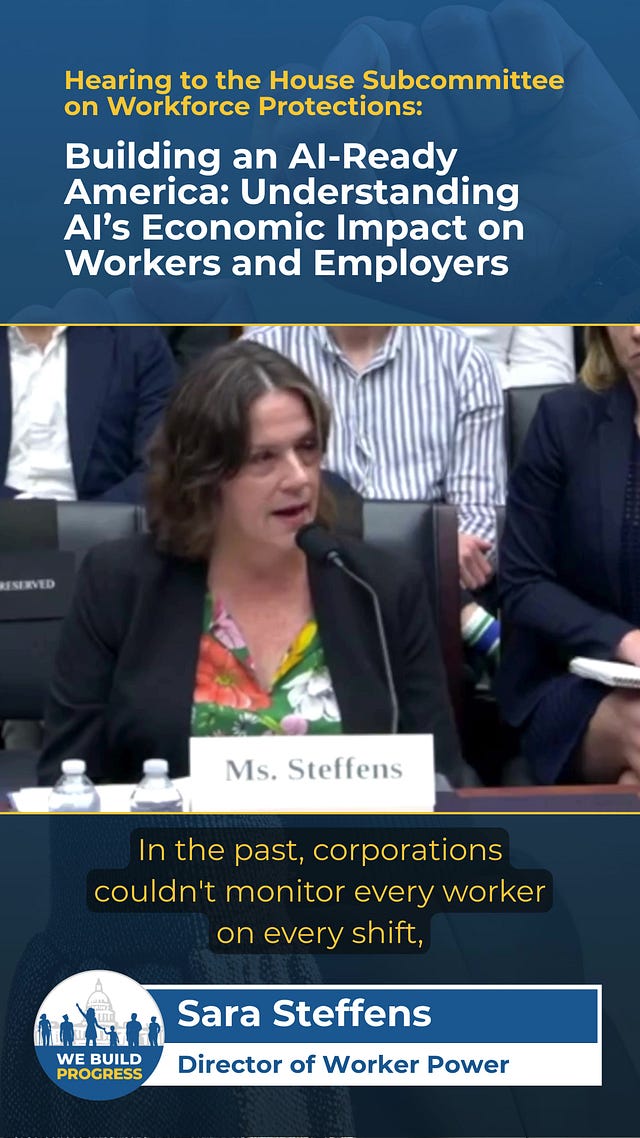
I was served a TikTok clip this week from the House Subcommittee on Workforce Protections hearing on “Building an AI-Ready America,” and even though the hearing happened in April, it hit a nerve immediately.
“People have almost no privacy protections at work and no federal law requires employers to notify workers about AI monitoring.” — Sara Steffens, Worker Power Director, We Build Progress
 Tiktok failed to load.
Enable 3rd party cookies or use another browser
Steffens’ testimony focused on workplace surveillance, algorithmic control, and opaque decision-making systems that workers often cannot see or challenge. She argued that AI can intensify old power imbalances by making it easier for employers to monitor, direct, discipline, and sideline people at scale. She also raised explicit concerns about AI-powered monitoring of keystrokes, mouse movements, social interactions, and behavioral data that frequently happen without meaningful worker consent.
What struck me is how familiar this debate already sounds. On one side, you have lawmakers and business voices arguing that America cannot regulate itself into falling behind, especially if states keep building a patchwork of rules companies have to navigate. On the other, you have worker advocates warning that AI is already being used to monitor people, shape their schedules, evaluate their performance, and make decisions they often cannot see or challenge.
This is not really a debate about whether AI will shape work. It already is. The real questions for me are the ones I have been conditioned to ask through my work on power, infrastructure, and information environments: who benefits, who gets protected, and who is harmed.
Learning How Humans Work
Before anyone writes this off as paranoid or anti-business, I do not think the answer is to pretend employers have no real concerns. They do. Companies want efficiency. They want security. They want consistency. They want tools that help people work faster and make fewer mistakes. Most clients and employers are not cartoon villains, and many are trying to figure this out in real time.
But working people are not paranoid for feeling a knot in their stomach when they hear this conversation. They are pattern-recognizing.
The workers already living the most intense version of this are not knowledge workers. Warehouse pickers, delivery drivers, call center agents, home health aides, fast food workers, gig workers — they have been surveilled, scored, and disciplined by algorithm for years, with the least recourse and the steepest consequences. There is extensive reporting on what that looks like, and I am not going to recreate it here. What I want to name is that when the surveillance economy reaches knowledge workers, it is not arriving. It is reaching upward through a labor hierarchy where it has already been operating on people with less leverage the entire time.
A manager starts “measuring productivity,” but what they are really doing is tightening control. A client starts “documenting process,” but what they are really doing is extracting your methods, your relationships, your thinking, your edge. A company says a tool is there to support workers, but somehow the tool keeps flowing upward into surveillance, scorekeeping, and replacement.
Earlier this year, reporting surfaced about xAI’s “human emulators” project, where AI trained by watching how people actually use their screens, then replaying those workflows as virtual workers at scale. The company had Grok trainers install monitoring software on personal computers to capture how they research and reason.
The labor implications are obvious. The implications for our information ecosystem — when AI agents are trained to replicate human research and reasoning at scale, then deployed into our feeds — is also terrifying.
And since the April hearing, the pattern has only become harder to ignore. Multiple outlets reported that Meta is rolling out internal software to track employee mouse movements, clicks, keystrokes, and periodic screen activity so the company can train AI agents to perform workplace tasks more effectively. The point, stated plainly, is to give the models real examples of how humans navigate systems, use shortcuts, and complete work on a computer.
The literal model is to watch the worker, capture the process, abstract the judgment, and call the result progress.
That is the line I do not think enough people are naming clearly. AI is not just replacing labor. It is learning from labor through surveillance.
When It Hits Knowledge Workers
For knowledge workers, this creates an insidious problem. Our value isn’t only in what we deliver — it is in the process of getting to the deliverable by way of problem solving. The way we frame a problem. The way we pressure-test a theory. The rough draft that never gets published. The notes in the margins. The abandoned route that helped us find the right one. The language we use to sharpen a message. The intuition we build through pattern recognition and trust.
Once that process becomes observable, trackable, and ingestible, everything starts to slide. The pre-work product becomes training data. The method becomes a workflow. The judgment becomes a feature. And the person who created the value becomes increasingly optional.
I have had a boss look at me and say, “Define free time.”
That line has stayed with me not because it was personally insulting but because it captures the worldview underneath all of this. If you are anywhere near a work device — on your own machine, on theirs, on the clock, off the clock, doing something work-adjacent, or simply thinking — your half-formed insights and creative leaps are treated as company property. Access becomes entitlement. Proximity becomes ownership. That mindset is what turns surveillance into doctrine.
As a consultant, I have already seen what happens when that doctrine meets AI. I have watched others monitor my work, my relationships, and my strategy. I have caught people feeding my work into AI systems even when my agreements and contracts explicitly prohibited it.
In one case, a man kept the sloppy notes with my name still in the margins of a “novel” model he claimed to have developed.
That is not a story about me, but rather about how casual the extraction has already become. How unbothered people are about provenance once they have convinced themselves that AI makes everything fair game. I have seen the Temu versions of my work produced by people feeding it into language models. They cannot replicate the expertise, the context, or the relationships behind the original. But they do not need to. They only need to be cheap enough and fast enough to make the original person look optional.
That is what extraction looks like in practice. Not a theoretical risk. A current business model.
Holding More Than One Truth
This is where I have to be honest about a tension I sit with.
I still believe knowledge should circulate in service of the work, not be hoarded behind institutional gatekeeping. Fields built on shared expertise are at their best when practitioners teach and learn from each other in the open.
But shared expertise only exists when the people producing it can afford to keep producing it. Extraction breaks the very thing it claims to value. The strategist whose work gets fed into AI without permission, repackaged without credit, and underpaid into the bargain is not going to keep producing. She is going to leave or build a wall around her work. Either way, the shared pool loses, and the people that work was meant to serve lose the infrastructure that took years to develop. There is a difference between choosing to share knowledge and having your labor extracted by institutions, clients, or companies that repackage it, monetize it, or feed it into AI systems without permission. One is collaboration. The other is enclosure.
Consent matters. Attribution matters. Compensation matters. The conditions that protect the worker are the conditions that protect the work itself.
The Union Angle
Steffens warned that AI surveillance can chill organizing and make it easier to identify and suppress workers trying to build power together. That should concern anyone who believes people deserve some leverage against institutions larger than themselves.
I come from a line of proud union-supporting blue-collar folks. My grandmother was a welder and labor organizer. And I grew up at a dinner table where union culture was the air in the room.
They worked in trades you could see. A foreman with a clipboard. A time clock on the wall. A file you could request and a grievance process you could file.
The protections their generations organized for, limits on surveillance, due process before discipline, the right to know what was in your record, the right to challenge it, the right to organize without being targeted for it, were built for a workplace you could point at.
While AI is not repealing those protections, it does route around them. The clipboard is now an algorithm. The paper file is a behavioral dataset you cannot see. The retaliation is a scheduling change, a performance score, a sudden reorganization no one will explain.
What worries me most about AI in this moment is how cleanly it adapts to the old anti-organizing playbook, just faster, quieter, and dressed up as objectivity. Identify the connectors, the influencers, the people building solidarity before they have done anything legally protected. Intervene or sideline them through selective enforcement, scheduling pressure, or algorithmic performance scores that provide plausible cover for retaliation.
Their generation fought to make those things harder to do in the open. My generation has to figure out how to fight them when they happen in systems we cannot see.
You do not have to be in a union for this to matter. Unchecked surveillance helps the powerful extract more from people while giving those people less recourse, less privacy, and less say.
Consent Is the Missing Line
I want to be clear about something, because the consent argument can get misread. I built Early Dawn. I use AI in some of my own work, in closed systems, to scale my methods, thinking, processes, and frameworks. The processes, inputs, and framing were mine, and I had every right to consent to that use. That consent does not extend to anyone else.
That distinction is the whole argument.
Using AI on your own work, with your own consent, is one thing. Having someone else surveil or use AI on your work, without your clear, direct, informed, written consent, is extraction. It does not become acceptable because the contract was vague, or because the technology is new, or because everyone else is doing it.
The fact that lawmakers are now debating this proves the concern is not imaginary. California’s AB 2027 would prohibit employers and vendors from using worker data to train or deploy AI systems that replicate, automate, or replace a worker’s job, and would prohibit selling or sharing that data for the same purposes. The bill analysis is striking in how directly it names the problem: worker data is fueling AI systems that can monitor, analyze, and ultimately replace people, often without their knowledge or consent.
Steffens (and the worker advocates she represents) are pushing for federal floors which include disclosure, data sale bans, human review, the right to appeal, and for states to retain the right to go further.
Two years ago, I drafted a proposal and sign-on letter calling for an industry-wide code of ethics to protect knowledge workers, consultants, and small businesses from exactly this kind of AI abuse. The concerns I named then, unauthorized IP use, missing attribution, misuse of expertise, are now recognized as billion-dollar industry risks, and organizations are scrambling to build protections around them.
What AI-Ready America Should Mean
If this country wants an AI-ready America, then “ready” cannot only mean faster, leaner, and cheaper. It has to mean workers, including independent workers, consultants, and knowledge workers, are not treated as training data with a pulse. It has to mean people are told when they are being monitored, can understand the systems making decisions about their work, and can challenge those decisions when they are wrong.
It has to mean consent is the floor, not the ceiling.
I am not arguing against AI. I am arguing against the idea that because a tool can observe, ingest, or replicate human work, it is therefore entitled to do so.
If we do not draw that line now, more and more of our personal data and what makes our work ours will be absorbed into systems we cannot see and have no standing to challenge. That should not be the cost of participating in the future.